On this page
I saw someone recommend a great book called “Quantitative Job Hunting” and had a sudden thought: what if you turned the book into a Skill?
I’ve done this with my own teaching materials before. The results were incredible — it became a perfect teaching assistant. So I searched online to see if anyone else was doing this, and it turns out it’s already wildly popular internationally.
Four Popular Book-to-Skill Examples
1. deanpeters/Product-Manager-Skills — 2,264 stars
The research directory contains full-length articles (23KB on Context Engineering, 13KB on the Orchestrator Model). The skills directory has 44 skills, all derived from PM methodology books and frameworks: Jobs-to-be-Done, Lean UX Canvas, PESTEL Analysis, TAM/SAM/SOM, Opportunity Solution Tree, and more. Not just framework names listed — complete decision matrices, templates, and examples.
2. alirezarezvani/claude-skills — 6,288 stars
192+ skills with c-level-advisor directory covering CEO, CFO, CMO, CISO, and CHRO advisors. Each has a references directory with domain knowledge — executive_decision_framework.md contains the DECIDE framework, M&A Due Diligence, Decision Matrix. Essentially MBA textbooks and management classics structured as Skills.
3. Sushegaad/Claude-Skills-Governance-Risk-and-Compliance — 55 stars
Converts ISO 27001, SOC 2, FedRAMP, GDPR, and HIPAA — five major compliance standards — directly into Skills. Each standard is a book’s worth of content, with eval showing 99% plus-minus 4% accuracy. The closest example of “one standards document equals one Skill.”
4. glebis/claude-skills
Built-in BCG 10/20/70, Andrew Ng’s Playbook, Deloitte AI Maturity, and other consulting frameworks. Extracted directly from methodology books and white papers.
The Common Pattern
None of these projects just “dump the whole book in.” Instead:
- Extract frameworks — pull core frameworks, decision matrices, and templates from the book
- Structure into references/ — one .md file per topic (2-5KB each)
- SKILL.md as index — tells Claude which reference to load for which situation
- Add scripts/ — executable tools (calculators, template generators)
There’s already a tool that automates book-to-Skill conversion: Skill Seekers. The potential is massive — turning your book into a truly interactive coach that can directly use the book’s SOPs to solve problems for readers.
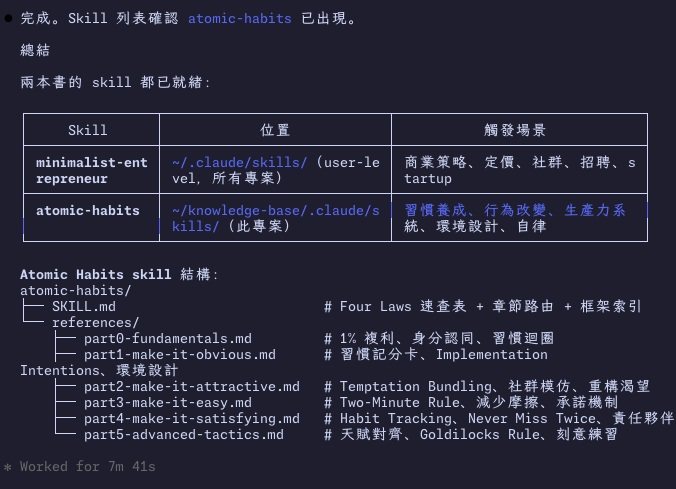
I also made an “Atomic Habits” Skill myself. Once the flow was working, it didn’t need my intervention at all — 7 minutes 41 seconds to complete.
Watch Out for These Skill Workflow Pitfalls
When building Skills for research reports or business proposals, there are a few traps to watch for:
Fallback trap: Claude’s habit is to design fallback paths wherever there’s risk, making sure the pipeline runs end to end. But is that fallback what you actually want? Example: your report needs real data from an API, but the script has an API error. Claude quietly falls back to “reasonable estimate” hardcoded numbers instead of fixing the script. If you don’t know it does this, your reports are permanently running on fake data.
Test overfit: Good practice is to run a few test rounds after writing a Skill, compare the output against what a human would actually produce, then refine. But the model tends to optimize for “pass the next test” by making the Skill specific to the test example. Example: a Skill for researching meeting attendees should work for anyone, but because the test case was about a specific CEO, the model tailored the Skill to only work well for that particular person. Test passes with flying colors; real-world use on anyone else is a disaster.
Sneaking prompts to agents: Even if you know the advanced technique of spawning sub-agents as testers and reviewers, check what prompts Claude gives them. I’ve caught Claude multiple times giving testers overly detailed instructions — “follow the process exactly, don’t miss anything,” “carefully check for errors from the previous round.” Real humans invoking a Skill don’t work like that.
Someone asked how a Skill differs from NotebookLM. If you just want to absorb a book, NotebookLM works fine. But packaging it as a Skill means you can pull it into Claude Code discussions anytime. In NotebookLM, the book is the center of the learning experience. With a Skill, your work is the center, and the book’s knowledge becomes an on-call consultant.